The central collector
One Rust server includes the telemetry API and web interface. Manage nodes, try the actual firmware on live data and update the display over USB.
Collector setupPublished releases & checksums
BUILD. REPAIR. MAKE IT YOURS.
The central collector, device agents, web interface, touchscreen firmware and printable case are open. Start with the software or build the display too.
Explore the current sourceCurrent main source · MIT software · CERN-OHL-P-2.0 enclosure
CHOOSE YOUR STARTING POINT
One Rust server includes the telemetry API and web interface. Manage nodes, try the actual firmware on live data and update the display over USB.
Collector setupPublished releases & checksumsPair once, then push native host readings from Windows, macOS or Linux. SNMP and JSON API adapters push normalized device readings. Proxmox and Moonraker retain their optional detail.
Agent setup & examplesHow to pair a deviceWaveshare V1 touch firmware, public USB update images and the current Portable r45 enclosure. Includes 23 printable parts, editable CAD, eight portable OrcaSlicer layouts and assembly notes.
Flash firmware in your browserBuild instructionsCurrent r45 CAD, print files & fit notesThe v0.5.6 release includes matching Linux collector and device-agent packages for x86-64 and ARM64. macOS collectors and Windows device agents can be built from the current source. Choose the package for your OS and architecture and verify its checksum. This release includes push enrollment, the integrated web interface and browser firmware updates.
The current collector, agent, firmware and Portable r45 source are on main. Download main source · Build it for your machine. The v0.1.0 downloads use the earlier architecture.
The working firmware targets the Waveshare ESP32-S3-Touch-LCD-2.8 V1 with ST7789 display and CST328 touch, 16 MB flash and 8 MB PSRAM. V1 is discontinued. V2 uses a different touch controller; its driver and physical fit are not validated.
Run one collector on Linux or macOS. Its host may be an ordinary server node, a Proxmox node on Linux, or omitted. Pair remote Rust agents with a one-time key; they receive a stable node identity and send readings without an incoming device port or feed URL. Add Moonraker and existing APIs as polling feeds. Names can change without changing identity. Up to four top-level nodes and eight nodes in total can be active, with sixteen remote nodes retained in configuration.
Windows is supported as a monitored device through the native Rust agent. The current central-server setup targets Linux and macOS. Devices expose what their hardware, APIs and permissions provide; temperatures and other hardware readings are optional.
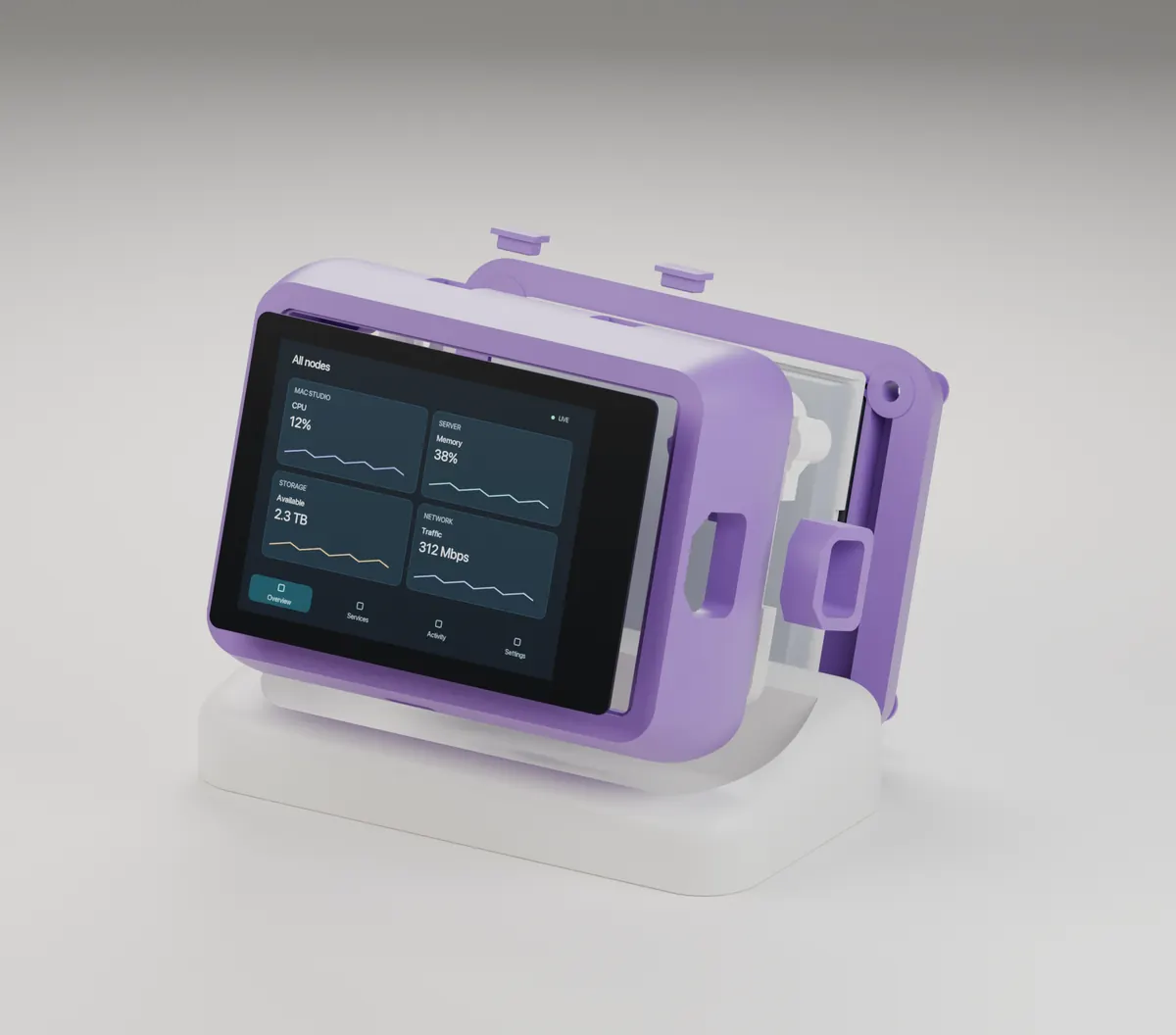
The collector ships the production C++ interface and LVGL renderer compiled to WebAssembly. Every pixel is rendered at the display’s native 320 × 240 resolution. The public demo uses that same renderer with four synthetic devices; your installed collector uses your live node feeds.
Chrome and Edge can write the public Waveshare V1 firmware over USB from the collector interface on HTTPS or localhost. Image hashes and board checks run before programming. The update preserves the saved Wi-Fi and collector pairing. Firmware source, relink material and license notices are supplied with the update bundle.
The portable agent-ops/v1 API and interactive browser preview cover task ownership, waiting states, queues, locks and reported usage. They are a native firmware workspace backed by a read-only Rust collector endpoint. Copy an integration prompt for your framework or collector.
The open-source Flipper app connects directly to Glimdock over paired Bluetooth LE. It receives System, Alerts, Agents and Printer pages, caches summaries for up to eight active nodes in RAM and keeps previously received details available while disconnected. Source age stays visible; closing the app clears the cache.
Build both ends from the same source revision. The official Flipper 1.5.1 app build passes; physical testing covers the Waveshare V1 display with Momentum mntm-012. The website installer supplies firmware v0.5.7 with this integration. Build the matching Flipper app from the v0.5.7 source revision.
Original software is MIT. Original enclosure designs use CERN-OHL-P-2.0. Third-party firmware, fonts, libraries and tools retain their own licenses and notices. The bought-in display board is a separate manufacturer’s product.
v0.1.0 is the earlier developer release, with Proxmox-first setup and the r7 enclosure. Use the current main source and its guides for push-agent enrollment, the integrated central collector and Portable r45 design.
Share your device model, board revision and sanitized logs when reporting a problem. Contributions to native probes, device APIs and tested enclosure fit are welcome.
Report an issue or suggest an idea